Evaluation Research and Studies

We help institutions, government agencies, nonprofit organizations, and companies verify whether their programs, projects, and initiatives are actually achieving their stated goals. Evaluation studies provide an independent and evidence-based assessment of what works, what does not work, and how a given activity can be improved.

We focus on evaluating public policies, grant programs, social and educational projects, communication campaigns, development strategies, and internal measures within organizations.
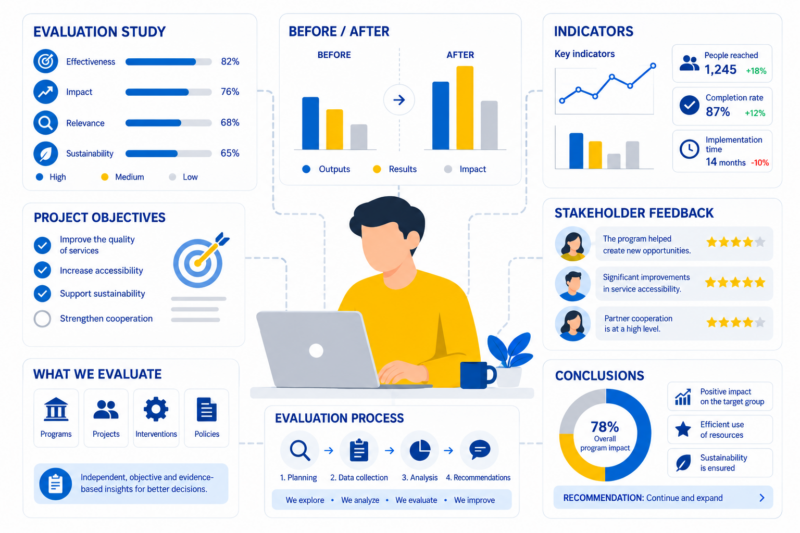
Find out whether your projects, programs, and initiatives are truly meeting their goals and delivering the expected results. We’ll help you identify what works, where barriers arise, and how to increase the effectiveness and real impact of your activities.

What the Evaluation Finds

Evaluation research answers key questions: whether the project’s objectives were met, how effectively available resources were utilized, what results and impacts the program produced, and whether it addressed the actual needs of the target groups. We evaluate not only the final outcome but also the implementation process itself—including process design, communication with target groups, collaboration among stakeholders, barriers to implementation, and factors that contributed to the project’s success or failure.

Types of Evaluation Studies

We conduct various types of evaluations depending on the project phase and purpose:

  • Initial evaluation —assessing the need for, relevance of, and design of the program before it begins
  • Ongoing evaluations – monitoring project implementation and early identification of problems
  • Final evaluations – assessment of the results achieved upon completion of the project
  • impact evaluations – assessments of the actual changes a program has brought about for its target groups
  • process evaluation – an analysis of how the project functioned in practice and where its management can be improved
A Combination of Methods and Perspectives

In our evaluations, we combine quantitative and qualitative methods—surveys, in-depth interviews, focus groups, document analysis, work with administrative data, and case studies. This allows us to link measurable data with a deeper understanding of the context and the participants’ experiences. We involve various target groups in our evaluations—beneficiaries, project implementers, partners, experts, institutional representatives, and the general public.

Outputs That Help with Decision-Making

Our reports do not merely describe our findings. They provide a clear interpretation of the results and specific recommendations for next steps—how to adjust the program, how to increase its effectiveness, where to remove barriers, and how to better structure follow-up activities. Evaluation studies thus serve not only as feedback but also as a practical tool for strategic planning, quality management, and responsible decision-making.

Why Commission Evaluation Research?

It’s not enough to know that a project was implemented. What’s important is to know whether it had real value, whom it helped, and what changes it brought about. Evaluation research will provide you with an independent perspective, evidence to support the results, and clear recommendations on how to increase the impact of future programs and use available resources more effectively.

Contact us