
Hana Růžičková
Sales and Project Manager
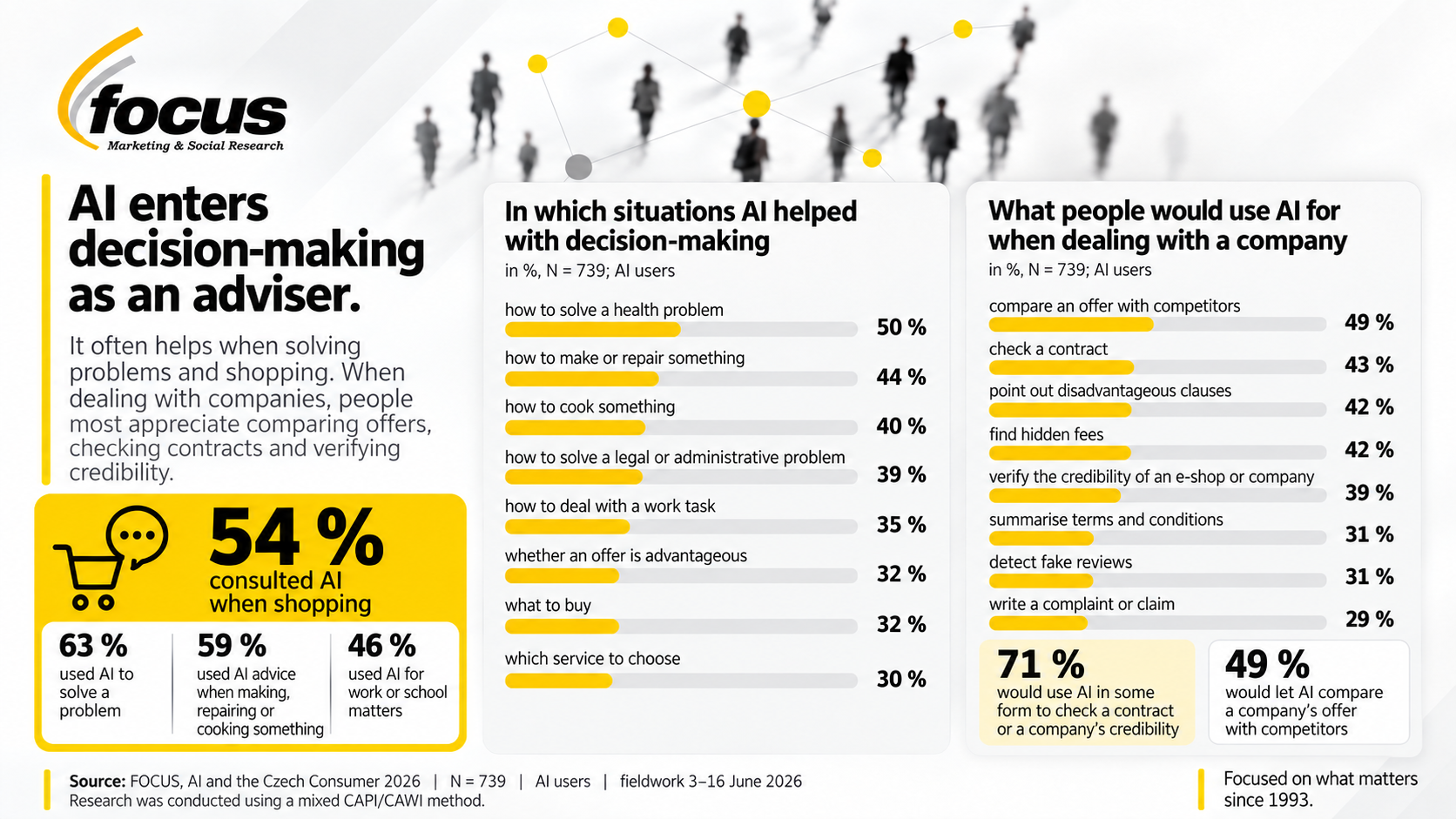
Artificial intelligence no longer just helps people work with text or search for information. It is increasingly involved in practical decision-making too – from dealing with health or legal issues and choosing products and services to reviewing contracts and assessing companies’ trustworthiness. The FOCUS study AI and the Czech Consumer 2026 shows that 54% of AI users consulted it in at least one shopping-related situation over the past year.
AI’s role is rapidly shifting from a general information tool to a personal adviser. 63% of AI users used it over the past year to help them deal with a problem – such as a health-related, legal, administrative or personal issue.
Everyday practical tasks also feature prominently. 59% of users turned to AI for advice on making or repairing things or cooking, while 46% used it to help with work or school-related matters.
Among specific situations, health-related problems top the list, with AI helping 50% of users in this area. This is followed by help with making or repairing something (44%), cooking (40%), and dealing with a legal or administrative issue (39%).
For businesses, the key finding is that AI is becoming directly involved in the customer journey. 54% of AI users said it had helped them in at least one shopping-related situation over the past year.
People use it, for example, to assess whether an offer is a good deal, choose a specific product, decide on a suitable service or find somewhere to make a purchase.
AI is thus gradually becoming another source of information that can influence which brand a customer considers, how they assess an offer and what they compare it with.
AI’s role becomes even more apparent when consumers deal directly with a company.
49% of AI users would ask it to compare a company’s offer with those of its competitors.
43% would use AI to review a contract, and 42% to flag unfavourable clauses or look for hidden fees. Meanwhile, 39% would use AI to check the trustworthiness of an online store or company.
Overall, 71% of AI users would use artificial intelligence for some form of contract review or to check a company’s trustworthiness.
This represents an important shift for brands themselves. Customers no longer assess an offer solely on the basis of information provided by the company. Within moments, they can ask AI to explain an offer, compare it with competing offers, look for unfavourable terms or check whether the company appears trustworthy.
Businesses therefore face a new task: monitoring not only what customers find about them through search engines, comparison sites or reviews, but also how AI interprets their brand, products and terms and conditions.
The research findings suggest that, for now, AI most often serves as an adviser and a tool for checking information. This is precisely why businesses should start treating it as another part of the customer journey.
The AI and the Czech Consumer 2026 study was conducted by research agency FOCUS among a sample of the Czech population aged 18 and over. The findings presented in this section are based on responses from 739 AI users. Data were collected from 3 to 16 June 2026 using a combination of CAPI and CAWI methods.
In the next articles in our series, we will explore which tasks people are willing to let AI handle independently and where they prefer to keep the final decision in their own hands.

Hana Růžičková
Sales and Project Manager

Lubomír Rejda
Head of the Sales and Project Department

Roman Skotnica
Chief Executive Officer
Roman Skotnica
Chief Executive Officer
I co-founded the FOCUS agency with two classmates while I was still a student. I currently serve as its executive director. I have more than 30 years of experience managing projects in the fields of market research, public opinion polling, and sociological research. I specialize primarily in brand research, customer segmentation, and finding practical answers to clients’ strategic questions.
I’m also known for my dedication to work—so far, I consider work-life balance more of an interesting research topic than a personal life strategy. But when I do take a break from work, I love heading out to the water. I’m a passionate angler, and fishing is one of the few activities during which I can wait patiently for several hours without feeling the need to analyze anything.
Hana Růžičková
Sales and Project Manager
As a sales and project manager, I’ve been ensuring for the past eight years that our clients find answers to their questions through research and move their businesses forward. I primarily work with international clients, and for me, the unique characteristics of each culture present both the greatest challenge and the greatest opportunity. If you need to carry out a research project, I’ll be with you from start to finish and help you navigate the entire process smoothly.

Filip Rozsíval
Head of the Analytics Department
For more than 15 years at FOCUS, I’ve been searching through data to find what isn’t immediately apparent. I enjoy uncovering connections, translating numbers into clear conclusions, and ensuring that every result is backed by thorough analysis. I’m thorough, systematic, and perhaps a bit of a stickler when it comes to data—but it’s often the details that determine whether an analysis yields real insight or just another spreadsheet. And since some connections only become clear over a second cup of coffee, I need not only good data but also good coffee to do my job.

Petr Horn
Head of the Collection Department
I’ve been at FOCUS since 2007—so long that, in my own words, I’m practically an inventory number here and know every little screw. I started out in telephone research, but gradually moved on to data, technology, and finding ways for my team and me to collect even the seemingly uncollectible. Since 2019, I’ve been leading the data collection department and have long been involved in developing our own system for CAPI, CATI, and CAWI research. When a project hits a snag, I try to keep a level head and find a solution. Outside of work, I enjoy exploring architecture and interesting places, including as a volunteer for the Open House Brno festival.

Lýdia Barbušová
Call Center Manager
I’ve been with FOCUS since 2007, when I joined the company with the task of setting up and managing the call center. And since I’m still managing it today, you could say that this task has taken a bit longer than expected. I specialize in managing and carrying out projects through telephone surveys. I communicate with clients, coordinate the progress of projects, and train and manage a team of telephone operators.
I have also been involved for a long time in the development of our internal telephone survey system—from defining requirements and testing to its ongoing modifications and further development. Thanks to this, I know all too well that the phrase “it’ll just be a small change” can mean almost anything.

Barbora Malá
Questionnaire and Data Collection Designer
I’ve been with FOCUS since 2010, when I started as an external interviewer at the call center. During my master’s program, I worked here as a supervisor, and after completing my degree, I took on the role of call center manager in 2020. Since 2024, I have been focusing on questionnaire design, where I draw on the experience I’ve gained throughout the entire data collection process. I ensure that the research brief is turned into a functional questionnaire and that the collected responses become high-quality data—I program and technically configure the questionnaires, monitor their logic, and, after data collection is complete, I clean and verify the data so that it is ready for further processing.

Lada Svobodová
Project Manager, Interviewer Network Management
I’ve actually been with FOCUS sort of since birth—thanks to family ties, I grew up with the company long before I actually started working there. I officially joined the team in September 2019 after finishing my studies, when I started as a data collection coordinator. Even during my parental leave, I stayed in touch with FOCUS and continued to work with them on a freelance basis.
Today, I’m expanding my role at FOCUS into other areas. I manage the company’s social media and online communications, and I’m also becoming increasingly involved in business activities and developing relationships with clients and partners. Thanks to my experience in carrying out research projects, I have a deep understanding of how the agency works from the inside, and I’m now applying that knowledge to identify new business opportunities.
To me, FOCUS is simply more than just a job—after all, we’ve known each other our whole lives.

Tereza Kurková
Data Collection Coordinator
I’ve been working in research for 18 years. I started out in mystery shopping and coordinating mystery shoppers, and over time I’ve worked with virtually every data collection methodology. Today, I’m most involved in focus groups and face-to-face projects. My work is mainly about people—and that’s exactly what I love about it. I enjoy communicating, organizing, and finding ways to see things through to the end, even when unexpected challenges arise during a project. And there have been quite a few of those over the past 18 years. I like it when everything goes as planned, people know what they’re supposed to do, and in the end, the job is well done. That’s probably why I still enjoy coordination even after all these years.

Jan Šírek
Data Collection Coordinator
At FOCUS, I work as the interviewer network coordinator, and I’ve been in the market research field for six years now. I’m responsible for coordinating interviewers and ensuring the successful implementation of projects that use various data collection methods. Part of my job also involves the technical setup of focus groups, where I make sure everything runs smoothly. What I appreciate most about my work is its diversity—every project brings different requirements, new situations, and often the need to quickly find practical solutions.

Jaromír Volek
Senior Analyst for Media and Political Communication
Jaromír Volek is a media sociologist who has long been engaged in research on the professional roles of Czech journalists and the analysis of news coverage. He co-founded the FOCUS agency while still a student at Masaryk University, where he also taught mass communication theory from 1994 to 2018. In recent years, he has focused on researching the reception strategies and tactics of heavy consumers of disinformation and conspiracy theories. He is the author of several academic monographs and numerous studies and chapters published by both domestic and international publishers.

Klára Bučková
Analyst
At FOCUS, I specialize in qualitative research, facilitating focus groups, and analyzing both qualitative and quantitative data. I switch effortlessly between SPSS and live discussions around the table—I’m just as comfortable with numbers as I am with people. I enjoy uncovering connections that aren’t immediately obvious and getting more out of respondents than just the first answer that comes to mind. I believe there’s no such thing as a boring focus group—only a poorly phrased question.

Michal Theuer
Senior Analyst
I have been working as a data analyst at FOCUS since 2016. My job involves transforming data into charts and final reports, the results of which I interpret and present to clients. I strive to replace boring numbers with statistically meaningful insights. In addition to standard analytical work, I also focus on methods where charts and tables aren’t enough—such as conjoint analysis, segmentation, psychographic profiling, correspondence analysis, and the creation of interactive dashboards.
Lubomír Rejda
Head of the Sales and Project Department
For many years, I worked in marketing at innogy and ČEZ. I joined FOCUS in 2016 as the head of the Sales and Project Department. I specialize in research on customer experience, satisfaction, and loyalty. I also enjoy challenges outside of work. When cycling, I tend to choose long and challenging routes, and when traveling, I prefer to backpack and visit places that typical tours don’t often go to.