
Hana Růžičková
Sales and Project Manager
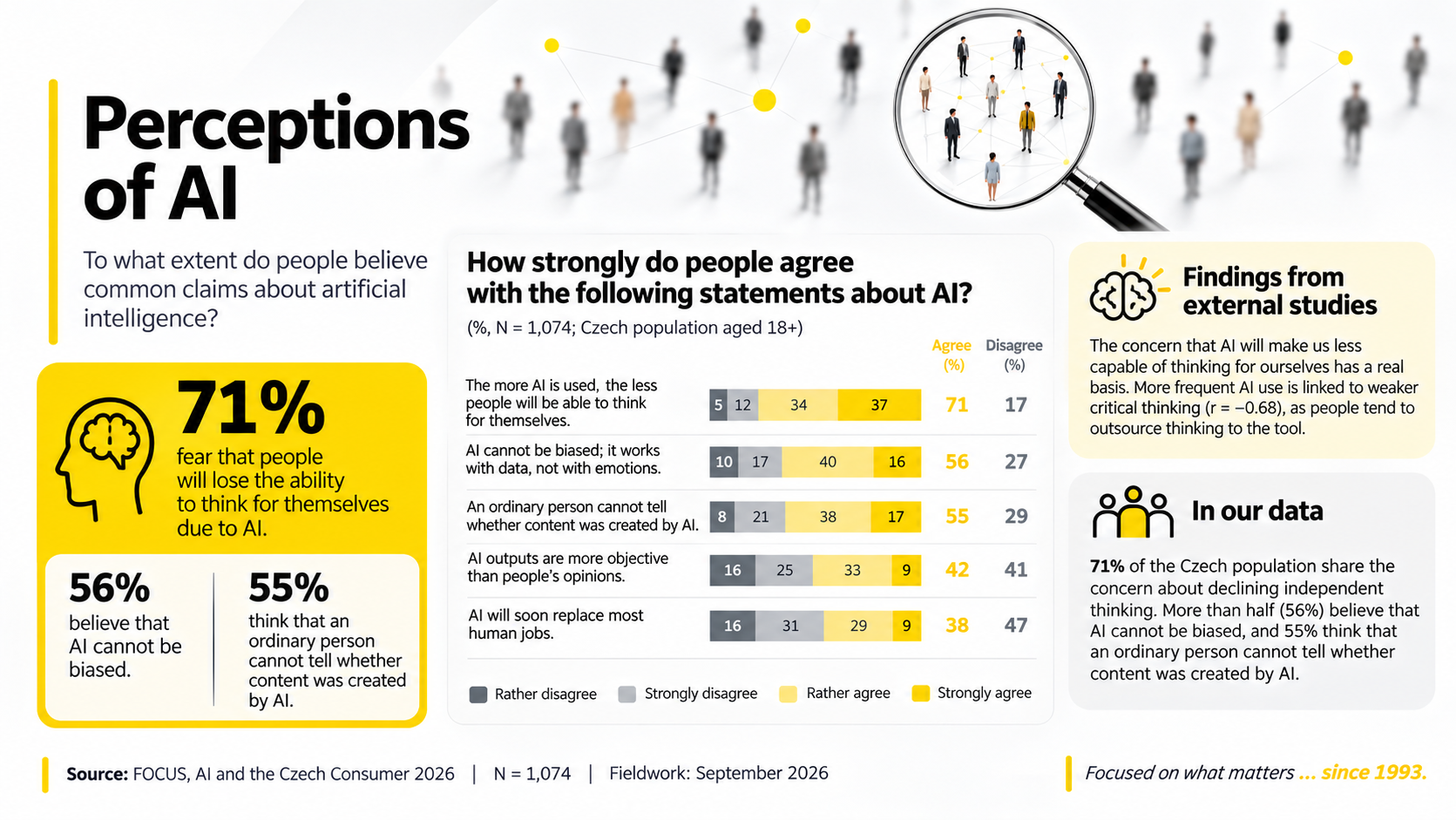
Artificial intelligence is rapidly becoming a common part of both work and everyday life. But as its use expands, so do concerns about how it may change the way we think. The FOCUS study AI and the Czech Consumer 2026 shows that 71% of Czech adults agree with the statement that the more we use AI, the less capable we will become of thinking independently. At the same time, several widespread assumptions about the impartiality and capabilities of AI persist.
Of all the statements about artificial intelligence tested in the study, the strongest concern is the potential loss of independent judgement. 71% of respondents agree that the more AI is used, the less capable people will become of thinking independently.
This concern is even more pronounced among people with higher levels of education. It is shared by 78% of respondents with upper-secondary education and by as many as 81% of university graduates.
The finding suggests that the Czech public does not view the rise of AI merely as a technological change. An increasingly important question is whether the growing availability of ready-made answers, recommendations and solutions could gradually reduce our own ability to form independent judgements.
Alongside concerns about the impact of AI on thinking, there is also relatively strong confidence in its supposed objectivity.
56% of adults agree with the statement that AI cannot be biased because it works with data rather than emotions. This is, however, a potentially problematic assumption. AI outputs depend on the data on which systems were trained, the way they are designed, and the context of a particular prompt. The fact that an answer is produced by a machine does not automatically make it impartial.
Our research also reveals a relationship between this belief and willingness to trust AI: people who believe that AI cannot be biased accept AI recommendations without verification approximately twice as often as sceptics — 10% compared with 5%.
Another widespread belief concerns the ability to recognise AI-generated content.
55% of respondents believe that an ordinary person cannot tell whether content was created by AI. This view is even more common among people aged 65 and over, where 65% agree with the statement.
As the quality of AI-generated text, images, audio and video continues to improve, the question of content origin is likely to become increasingly relevant — not only for the media, but also for marketing communication, customer reviews and everyday interpersonal communication.
On the other hand, the results show that the Czech public does not simply see artificial intelligence as a “digital human”.
55% of respondents disagree with the statement that AI can think in a way similar to humans. Only 30% agree.
People are similarly cautious about the idea that AI will soon replace most human work. 38% agree with this statement, while 47% disagree.
So while the public attributes certain capabilities and a degree of objectivity to AI, most people still reject the idea that it actually thinks in the same way as a human being.
The Czech findings are also interesting when viewed in the context of academic research.
A study involving 666 respondents in the United Kingdom found a strong negative association between frequent AI use and critical thinking. One possible explanation is so-called cognitive offloading — the transfer of part of our mental work to external tools.
This in itself is nothing new. People have always reduced mental effort by using notes, calculators, search engines or navigation systems. AI, however, allows people to delegate much more complex parts of the process — not only finding information, but also interpreting it, formulating arguments or even proposing decisions.
A study from MIT also attracted considerable attention. Participants were asked to write essays either with ChatGPT, with an internet search engine, or without technological assistance. The group using ChatGPT showed the weakest connectivity between the monitored brain regions and a lower ability to recall their own text. The authors themselves caution that this was a limited experimental study and that its results cannot simply be generalised to all forms of AI use.
Other research has also shown that people tend to attribute greater objectivity to automated systems than those systems actually possess. The combination of conveniently available answers and high trust may therefore reduce the motivation to critically assess AI-generated outputs.
These findings do not necessarily have to be interpreted as an argument against using artificial intelligence. The key question is rather how we use it.
AI can offer an alternative perspective, quickly summarise large amounts of information, suggest arguments or highlight connections that a person may have overlooked. But if we start using it as a source of ready-made answers that we no longer question, we may indeed transfer part of our own mental work to the tool.
What matters, then, may not be simply how often we use AI, but whether it helps us think better — or whether it thinks instead of us.
The AI and the Czech Consumer 2026 study therefore reveals an interesting tension. Czechs are strongly concerned that AI could weaken independent thinking, yet at the same time more than half of the population attribute a level of impartiality to AI that cannot automatically be assumed.
The ability to work critically with AI outputs may therefore become one of the key competencies in a world where artificial intelligence is an increasingly common part of everyday decision-making.
Methodology: The study was conducted on a sample of N = 1,074 respondents, representative of the Czech population aged 18+. Fieldwork took place in September 2026.
The external studies cited in the article serve as an interpretative framework. They involve different populations, methodologies and data-collection periods and therefore should not be treated as direct comparisons with the FOCUS study.

Hana Růžičková
Sales and Project Manager

Lubomír Rejda
Head of the Sales and Project Department

Roman Skotnica
Chief Executive Officer
Roman Skotnica
Chief Executive Officer
I co-founded the FOCUS agency with two classmates while I was still a student. I currently serve as its executive director. I have more than 30 years of experience managing projects in the fields of market research, public opinion polling, and sociological research. I specialize primarily in brand research, customer segmentation, and finding practical answers to clients’ strategic questions.
I’m also known for my dedication to work—so far, I consider work-life balance more of an interesting research topic than a personal life strategy. But when I do take a break from work, I love heading out to the water. I’m a passionate angler, and fishing is one of the few activities during which I can wait patiently for several hours without feeling the need to analyze anything.
Hana Růžičková
Sales and Project Manager
As a sales and project manager, I’ve been ensuring for the past eight years that our clients find answers to their questions through research and move their businesses forward. I primarily work with international clients, and for me, the unique characteristics of each culture present both the greatest challenge and the greatest opportunity. If you need to carry out a research project, I’ll be with you from start to finish and help you navigate the entire process smoothly.

Filip Rozsíval
Head of the Analytics Department
For more than 15 years at FOCUS, I’ve been searching through data to find what isn’t immediately apparent. I enjoy uncovering connections, translating numbers into clear conclusions, and ensuring that every result is backed by thorough analysis. I’m thorough, systematic, and perhaps a bit of a stickler when it comes to data—but it’s often the details that determine whether an analysis yields real insight or just another spreadsheet. And since some connections only become clear over a second cup of coffee, I need not only good data but also good coffee to do my job.

Petr Horn
Head of the Collection Department
I’ve been at FOCUS since 2007—so long that, in my own words, I’m practically an inventory number here and know every little screw. I started out in telephone research, but gradually moved on to data, technology, and finding ways for my team and me to collect even the seemingly uncollectible. Since 2019, I’ve been leading the data collection department and have long been involved in developing our own system for CAPI, CATI, and CAWI research. When a project hits a snag, I try to keep a level head and find a solution. Outside of work, I enjoy exploring architecture and interesting places, including as a volunteer for the Open House Brno festival.

Lýdia Barbušová
Call Center Manager
I’ve been with FOCUS since 2007, when I joined the company with the task of setting up and managing the call center. And since I’m still managing it today, you could say that this task has taken a bit longer than expected. I specialize in managing and carrying out projects through telephone surveys. I communicate with clients, coordinate the progress of projects, and train and manage a team of telephone operators.
I have also been involved for a long time in the development of our internal telephone survey system—from defining requirements and testing to its ongoing modifications and further development. Thanks to this, I know all too well that the phrase “it’ll just be a small change” can mean almost anything.

Barbora Malá
Questionnaire and Data Collection Designer
I’ve been with FOCUS since 2010, when I started as an external interviewer at the call center. During my master’s program, I worked here as a supervisor, and after completing my degree, I took on the role of call center manager in 2020. Since 2024, I have been focusing on questionnaire design, where I draw on the experience I’ve gained throughout the entire data collection process. I ensure that the research brief is turned into a functional questionnaire and that the collected responses become high-quality data—I program and technically configure the questionnaires, monitor their logic, and, after data collection is complete, I clean and verify the data so that it is ready for further processing.

Lada Svobodová
Project Manager, Interviewer Network Management
I’ve actually been with FOCUS sort of since birth—thanks to family ties, I grew up with the company long before I actually started working there. I officially joined the team in September 2019 after finishing my studies, when I started as a data collection coordinator. Even during my parental leave, I stayed in touch with FOCUS and continued to work with them on a freelance basis.
Today, I’m expanding my role at FOCUS into other areas. I manage the company’s social media and online communications, and I’m also becoming increasingly involved in business activities and developing relationships with clients and partners. Thanks to my experience in carrying out research projects, I have a deep understanding of how the agency works from the inside, and I’m now applying that knowledge to identify new business opportunities.
To me, FOCUS is simply more than just a job—after all, we’ve known each other our whole lives.

Tereza Kurková
Data Collection Coordinator
I’ve been working in research for 18 years. I started out in mystery shopping and coordinating mystery shoppers, and over time I’ve worked with virtually every data collection methodology. Today, I’m most involved in focus groups and face-to-face projects. My work is mainly about people—and that’s exactly what I love about it. I enjoy communicating, organizing, and finding ways to see things through to the end, even when unexpected challenges arise during a project. And there have been quite a few of those over the past 18 years. I like it when everything goes as planned, people know what they’re supposed to do, and in the end, the job is well done. That’s probably why I still enjoy coordination even after all these years.

Jan Šírek
Data Collection Coordinator
At FOCUS, I work as the interviewer network coordinator, and I’ve been in the market research field for six years now. I’m responsible for coordinating interviewers and ensuring the successful implementation of projects that use various data collection methods. Part of my job also involves the technical setup of focus groups, where I make sure everything runs smoothly. What I appreciate most about my work is its diversity—every project brings different requirements, new situations, and often the need to quickly find practical solutions.

Jaromír Volek
Senior Analyst for Media and Political Communication
Jaromír Volek is a media sociologist who has long been engaged in research on the professional roles of Czech journalists and the analysis of news coverage. He co-founded the FOCUS agency while still a student at Masaryk University, where he also taught mass communication theory from 1994 to 2018. In recent years, he has focused on researching the reception strategies and tactics of heavy consumers of disinformation and conspiracy theories. He is the author of several academic monographs and numerous studies and chapters published by both domestic and international publishers.

Klára Bučková
Analyst
At FOCUS, I specialize in qualitative research, facilitating focus groups, and analyzing both qualitative and quantitative data. I switch effortlessly between SPSS and live discussions around the table—I’m just as comfortable with numbers as I am with people. I enjoy uncovering connections that aren’t immediately obvious and getting more out of respondents than just the first answer that comes to mind. I believe there’s no such thing as a boring focus group—only a poorly phrased question.

Michal Theuer
Senior Analyst
I have been working as a data analyst at FOCUS since 2016. My job involves transforming data into charts and final reports, the results of which I interpret and present to clients. I strive to replace boring numbers with statistically meaningful insights. In addition to standard analytical work, I also focus on methods where charts and tables aren’t enough—such as conjoint analysis, segmentation, psychographic profiling, correspondence analysis, and the creation of interactive dashboards.
Lubomír Rejda
Head of the Sales and Project Department
For many years, I worked in marketing at innogy and ČEZ. I joined FOCUS in 2016 as the head of the Sales and Project Department. I specialize in research on customer experience, satisfaction, and loyalty. I also enjoy challenges outside of work. When cycling, I tend to choose long and challenging routes, and when traveling, I prefer to backpack and visit places that typical tours don’t often go to.